What Piece of Art Did Lorna Simpson Win With
| Lorna Simpson | |
|---|---|
 Simpson in April 2009 | |
| Born | Lorna Simpson (1960-08-13) xiii Baronial 1960 Brooklyn, New York |
| Nationality | American |
| Education | University of California-San Diego, MFA, 1985; School of Visual Arts, New York City, BFA, 1983 |
| Known for | Photography, Film, Video |
| Move | Conceptual photography |
| Awards | 2010 ICP Infinity Honor in Art, International Center of Photography, New York City; 2019 J. Paul Getty Medal |
Lorna Simpson (built-in August thirteen, 1960) is an American lensman and multimedia artist. She came to prominence in the 1980s and 1990s with artworks such as Guarded Weather condition and Square Deal.[1] Simpson is virtually well-known for her piece of work in conceptual photography. Her works have been included in numerous exhibitions both nationally and internationally. She is best known for her photo-text installations, photo-collages, and films. Her early work raised questions nearly the nature of representation, identity, gender, race and history. Simpson continues to explore these themes in relation to memory and history in diverse media including photography, picture, video, painting, cartoon, sound, and sculpture.[two] [iii]
Early life [edit]
Lorna Simpson was built-in on August xiii, 1960 and grew upward in Crown Heights,[4] a neighborhood in Brooklyn, New York.[ane] She attended the High School of Art and Design. Her parents – a Jamaican-Cuban father and African-American mother –[5] moved from the Midwest to New York[6] and took her to numerous plays, museums, concerts and dance performances as a child.[7] In the summers, Simpson took courses at the Fine art Institute of Chicago while visiting her grandmother.[half-dozen]
Didactics [edit]
Prior to receiving her BFA, Simpson traveled to Europe, Africa, and the United States where she further adult her skills through documentary photography.[four] While traveling, she became inspired to aggrandize her work beyond the field of photography to challenge and engage the viewer. It is then that she expanded her art do to graphic design. Simpson later attended the School of Visual Arts in New York City where she received a Bachelor of Fine Arts in Painting in 1982.[4] During that time, she interned at the Studio Museum in Harlem, acquainting herself with the practice of David Hammons, among others, who was an creative person in residence.[5]
While earning her Master of Fine Arts caste in visual arts, from the University of California at San Diego in 1985,[8] Simpson further expanded her ideas. Her education in San Diego was somewhere between Photography and Conceptual art, and her teachers included conceptual creative person Allan Kaprow, performance creative person Eleanor Antin, filmmakers Babette Mangolte, Jean-Pierre Gorin and poet David Antin.[nine] What emerged was her signature style of "photo-text". In these photos Simpson inserted graphic text into studio-like portraiture. In doing so, Simpson brought an entirely new conceptual significant to the works. This new perspective and way of Simpson derived from her curiosity most whether or not documentary photography was factual or served equally a synthetic truth generated by documentary photographer themselves.[iv] These works generally related to analyzing and critiquing stereotypical narratives pertaining to gender and race[x] of African-American women within American culture.[one]
Career [edit]
In her work in the 1980s and 1990s, she tries to portray African-American women in a mode that is neither derogatory nor actual representations of the women portrayed.[11] Some artists that have influenced her piece of work include David Hammons, Adrian Piper, and Felix-Gonzalex Torres; and even some writers similar Ishmael Reed, Langston Hughes, Ntozake Shange, Alice Walker, and Toni Morrison because of their rhythmical vocalisation.[12] She was awarded a National Endowment for the Arts Fellowship in 1985, and in 1990, she became the first African-American woman to exhibit at the Venice Biennale.[xiii] She was as well the first African American adult female to have a solo exhibition in the Museum of Modern Art with her Projects 23 exhibition.[14] In 1990, Simpson had ane woman exhibitions at several major museums, including the Denver Art Museum, Denver, Colorado, the Portland Art Museum, Portland, Oregon, and the Museum of Modern Art, New York.[fifteen] [xvi] At the same time, her piece of work was included in The Decade Show: Frameworks of Identity in the 1980s, an exhibition presented by The Museum of Gimmicky Hispanic Art, The New Museum of Gimmicky Fine art, and The Studio Museum in Harlem.[14] Simpson has explored various media and techniques, including two-dimensional photographs besides as silk screening her photographs on large felt panels, creating installations, or producing as video works such as Call Waiting (1997).[17]
The figure slowly started to disappear from Simpson'due south work effectually the end of 1992, when her focus turned to aesthetic issues. Her interest in the human body remained during this time nevertheless she was trying to work through these problems without the image of the figure.[18] In 1997, Simpson received the Artist-in-Residence grant from the Wexner Center for the Arts in Columbus, Ohio, where she exhibited her works in photography. By the 2000s, she had started exploring the medium of video installations to avert a paralysis brought on past exterior expectations. In 2001, she was awarded the Whitney Museum of Art Award, and in 2007, her work was featured in a xx-year retrospective at the Whitney Museum of American Art in her hometown of New York Urban center.[ane] [17] [19]
Simpson's work has been displayed at the Museum of Modern Fine art, the Museum of Contemporary Fine art, the Miami Art Museum, the Walker Art Heart, the Minneapolis Institute of Art, and the Irish Museum of Modern Art,[20] the Whitney and the Studio Museum in Harlem, The Whitney Museum of American Fine art and the Venice Biennale, where she was the first African American to participate.[21] Her showtime European retrospective opened at the Jeu de Paume in Paris in 2013, and so traveled to Germany, England, and Massachusetts.[22] [23] [24] [25] She has likewise been one of a scattering of African-American artists to exhibit at the Jamaica Arts Centre in Queens, New York so to the gallery in Soho.[eighteen]
| External epitome | |
|---|---|
 Black America Again (anthology cover) Black America Again (anthology cover) |
She get-go exhibited paintings in 2015 at the 56th Venice Biennale, followed past a showing at the Salon 94 Bowery.[26] [27]
In 2016 Simpson created the album artwork for Blackness America Once again by Common. During the same yr, she was featured in the book In the Company of Women, Inspiration and Advice from over 100 Makers, Artists, and Entrepreneurs. [28] In a 2017 effect of Faddy Magazine, Simpson showcased a series of portraits of 18 professional creative women who hold art central to their lives. The women photographed included Teresita Fernández, Huma Bhabha, and Jacqueline Woodson. Inspired by their resilience, Simpson said of these women, "They don't take no for an respond".[29]
While she first built her career upon beingness a conceptual photographer, she has since explored diverse media including video, installation, drawing, painting and motion-picture show into her pieces.[xxx] Simpson's goal is to continue to influence the legacy of blackness artists today past speaking with artists and activists such as the Art Hoe Collective.[31] When asked virtually her career Simpson says, "I've always washed exactly what I wanted to exercise, regardless of what was out there. I merely stuck to that principle and I'one thousand a much happier person every bit a result. And I can't imagine trying to satisfy whatever particular audition".[32]
Piece of work [edit]
Simpson outset came to prominence in the 1980s for her large-scale works that combined photography and text and defied traditional conceptions of sexual practice, identity, race, culture, history, and memory. Primarily, Simpson is interested in exploring individual identities in her piece of work and the intersectionality of identities. She is well known for her exploration of the blackness female person identity, though she is besides interested in all identities, in the American identity, in universal figures, and universality.[33] Simpson is also interested in ambiguity in her work, she includes "gaps and contradictions then that non all the viewer's questions are answered."[34] Simpson'due south ambiguity frequently allows viewers to call back, to take in her piece of work and the larger questions that her piece of work raises. Simpson's "high level of conceptional sophistication and social awareness"[35] has gained her much positive attention, equally has her attending and employ of political issues in her work. Simpson has "seized on conceptualism'southward signature tropes-the filigree, seriality, repletion, and, to a higher place all, linguistic communication-to examine how our knowledge of the world comes to be organized."[36] Repetition of figures in "minimalist photographs"[12] and text creates a "interplay of text and images"[33] that "relies on repetition to make clear the difference that racialization makes."[37] Drawing on this work, she started to create big photos printed on felt that showed public just unnoticed sexual encounters. Recently, Simpson has experimented with picture as well every bit standing to piece of work with photography.[20] Simpson'southward "interests in photography [has] always been paralleled by an involvement in motion-picture show, peculiarly in the way that one structurally builds sequences in film."[33] Simpson began working in picture in 1997 with her piece of work Call Waiting and has connected such work in subsequent years.

Lorna Simpson, Untitled (2 Necklines), 1989,
2 gelatin silver prints and 11 engraved plastic plaques, forty ten 100 in.,
National Gallery of Fine art, Washington, DC
Simpson's 1989 work, Necklines, shows 2 circular and identical photographs of a black woman'southward oral cavity, chin, neck, and collar os. The white text, "band, environment, lasso, noose, eye, areola, halo, cuffs, collar, loop", individual words on black plaques, imply menace, binding or worse. The final phrase, text on scarlet "feel the ground sliding from under you," openly suggests lynching, though the side by side images remain serene, non-confrontational and elegant.[38]
Easy for Who to Say, Simpson'southward work from 1989, displays 5 identical silhouettes of blackness women from the shoulders up wearing a white top that is similar to women portrayed in other of Simpson's works. The women's faces are obscured by a white-colored oval shape each with i of the following letters inside: A, E, I, O, U. Underneath the corresponding portraits are the words: Amnesia, Error, Indifference, Omission, Uncivil. In this piece of work Simpson alludes to the racialization in ethnographic movie theater and the revocation of history faced by many people of color.[39] Besides, the messages covering the faces suggest "intimate multiplicity of positions she might occupy and attitudes she might presume-",[40] these potential thoughts are stopped, abruptly, past the words, "undermining not just the subjective position the figure would seek simply also her grasp on whatsoever recognizable position at all."[xl]
Simpson'due south work Guarded Conditions, created in 1989, was one in a series in which Simpson has assembled fragmented Polaroid images of a female model whom she has regularly collaborated with. The body is fragmented and viewed from behind, while the back of the model's caput is sensed every bit being in a state of guardedness towards possible hostility she can anticipate equally a outcome of the combination of her sex and the colour of her skin. The complex historical and symbolic associations of African-American hairstyles are also brought into play. The bulletin of the text and the formal handling of the image reinforce a sense of vulnerability. One can also annotation that the figures, though in similar poses, differ slightly in the placement of the figure'south feet, hair, and hands. These subtle differences might suggest, "the model's shifting relationship to herself."[41] The fragmentation and serialization of bodily images disrupts and denies the body'south wholeness and individuality. In attempting to read the work the viewer is provoked into confronting histories of appropriation and consumption of the black female body.[42] Many critics associate this work with the slave auction, equally a reminder that black "enslaved women were removed from the circle of human suffering so that they might become circulating objects of sexual and pecuniary substitution."[43] These women had no pick but to stand up on the auction block and put themselves, their bodies, on brandish for sell. They become objects, a subject that Simpson often makes the focus of her piece of work.[44]
Simpson besides incorporated the complicated human relationship that African American women have with their natural hair in her piece of work Wigs (1994). The assortment of wigs ranges from afros, braids and blonde locks of human, yak and synthetic hair mounted adjacent.[45] Simpson's Wigs (1994) does not include whatsoever figures, instead the line up wigs propose scientific specimens.[46] Simpson explains in an interview on Wigs (1994) "This piece of work came at a signal where I wanted to eliminate the figure from—or eliminate its presence from the work, but I nevertheless wanted to talk about that presence." [45] According to the Museum of Modernistic Fine art, Learning folio, the piece of work has diverse social and political undertones about the surrounding culture and the beauty standards that the culture produces. As such, the work forces the viewer to question why such beauty standards exists and how they are perpetuated past society.[47] Though Simpson's work often centered effectually bug of personal memory, it was not until 2009 that Simpson introduced self-portraiture into her trunk of work. Her series 1957–2009 included vintage black and white photographs depicting "found pinup-style images of a young African American women" from 1957, juxtaposed against cocky-portraits in which Simpson reproduced the backdrop and the model's pose in the context of the present day. Simpson thus recreated a narrative of dazzler ideals that excluded black women in the 1950s.[48]
In 2009, Simpson created a piece chosen May, June, July, August '57/'09 #eight. In this work, Simpson combined photographs of herself alongside a series of photos that she caused through eBay. The photos she had bought off eBay were of an unidentified woman, and occasionally a male, in staged and bonny poses. When she received the photos, she hung them on her wall where they stayed for months. Eventually, she decided to recreate the images by taking photos of herself in the same pose and wear as the woman in the photos in 2009.[49]
Simpson's work often portrays black women combined with text to express contemporary society'south relationship with race, ethnicity and sex. In many of her works, the subjects are black women with obscured faces, causing a denial of gaze and the interaction associated with visual commutation. Simpson'south use of "turned-back figures" was used to not simply "refuse the gaze" but to also "to deny any presumed admission to the sitter's personality, and to refute both the classificatory drives and emotional projections typically satisfied by photographic portraiture of black subjects."[50] Information technology has also been suggested that these figures "stand up for a generation's way of looking and questioning photographic representation"[33] Through repetitive employ of the same portrait combined with graphic text, her "anti-portraits" have a sense of scientific classification, addressing the cultural associations of black bodies.[51]
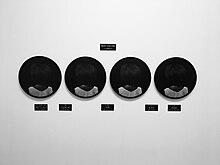
Lorna Simpson, Xx Questions, (A Sampler), 1986, 4 photographs, gelatin silver prints on newspaper and six engraved plastic plaques.
In a 2003 video installation, Corridor, Simpson sets two women side-by-side; a household servant from 1860 and a wealthy homeowner from 1960.[52] Both women are portrayed by artist Wangechi Mutu, allowing parallel and haunting relationships to be drawn.[xix] She has commented, "I do not announced in any of my piece of work. I recall maybe there are elements to information technology and moments to it that I utilise from my own personal experience, merely that, in and of itself, is not so important as what the work is trying to say about either the style we interpret experience or the way nosotros interpret things about identity."[17]
Simpson's interest in using sound elements in her works to add "layering" helps to fix the tone and mood of a composition. In Corridor music is used to create "an interesting melding visually of two time periods."[53] The music is sometimes lulling and others sharp, terrifying, and haunting, which correlates with the narrative. Simpson oft uses "open-concluded narratives"[53] in photography and film because she is interested in "insinuating things",[53] she does this in Corridor, where "nix really happens, it'southward just a adult female going kind of day-to-day, what she does over the grade of a solar day."[53] A "texture" begins to appear that begins to tell viewers what might exist going on, it begins to make viewers question "what's missing from the picture" and "what ['southward] trying to [exist] conveyed."[53] All of these questions begin to create a setting, a "time frame" or "menses of time" to encourage a viewer to create or imagine or effigy out a narrative, to figure out "these people lives during a particular period of time that is important politically."[54] The viewer can then digest that political surroundings in present day, they can discover associations with their ain political climate. In the case of Corridor, the women's mean solar day-to-twenty-four hours life, and the mood of the video, dark and lonely, are more than similar that i might expect. In this example, Simpson is considering identity again while also considering the past and the event of the past on the present. Simpson is exploring race and form, the piece of work attempts "to explore American identity and constructions of race."[54]
From 2009 until 2018, Simpson shared a four-story studio with her then-husband James Casebere; the building was David Adjaye's first completed project in the US.[55] In 2014, she spent a iii-calendar week residency at collector Pamela Joyner'south Sonoma, California, estate.[6] In 2018, she moved into a new studio at the Brooklyn Navy Yard.[56] [5]
Starting from 2016, Lorna Simpson started to include series into her piece of work. In 2016 she published a slope series that displayed ink and screen print on claybord with various pocket-sized drawing in black and white. In 2016–2017 she had a caput on ice series. These pieces were on ink and screen print on gessoed fiberglass. This artwork was also in blackness and white, with a few in black, white, and blue to correspond the water ice. The artwork displayed women of colour who were depicted in black or blue and their heads were emphasized in each photograph. From 2017-2018, she did an ice series. There is a common theme of blue, white, and blackness as her main colors of expression so far. In 2018 a montage serial. In 2019, she did another ice series along with a special character serial. From 2016 to 2019 she adult a large figurative series. This series includes many interactions of women with unlike levels of expression. Information technology yet holds the same theme of blueish, black, and white.
I of these almost recent series of hers that was created in 2019 is chosen Special Character series. In this series, Lorna Simpson uses photographic collages to challenge race and gender stereotypes.[57] Special Grapheme 1, Special Grapheme two, and Special Graphic symbol 5 in this series consists of Black women who are shimmering in beautiful shades of ruby, yellow, blue, and blackness. They are boldly present and their gazes are stiff and fierce. Special Character #1 depicts a bisected adult female, surrounded by a cloud of yellow color, capturing the viewers with her threefold gaze. Special Character #2 consists of a superimposed woman who is enclosed or enraptured in a cube of sapphire-like ice.[58] Simpson's piece of work in this serial delivers a potent bulletin against racism and sexism.[59]
Personal life [edit]
Simpson currently lives and works in Brooklyn.[60] From 2007 until 2018, she was married to fellow creative person James Casebere.[6] They have a daughter, Zora Casebere, an artist and Instagram personality.[61]
Recognition [edit]
- 1985 – National Endowment for the Arts Fellowship, United States[1]
- 1987 – Workspace Grant, Jamaica Arts Eye[62]
- 1989 – Artists Space board of directors, New York, NY
- 1990 – Louis Condolement Tiffany Award, Louis Condolement Tiffany Foundation, New York, NY
- 1994 – Artist Award for a Distinguished Torso of Work, Higher Fine art Association, New York, NY[63]
- 1997 – Artist-in-Residence Grant, Wexner Middle for the Arts, Columbus, OH[63]
- 1998 – Finalist, Hugo Boss Prize 1998, Solomon R. Guggenheim Foundation, New York, NY
- 2001 – Whitney Museum of American Art Laurels, sponsored by Cartier and the Cartier Foundation for Contemporary Art, New York, NY
- 2003 – Distinguished Artist-In-Residence, Christian A. Johnson Try Foundation, Colgate University, Hamilton, NY
- 2014 – Shortlisted, Deutsche Börse Photography Prize[64]
- 2018 – SMFA Medal Honour, Schoolhouse of the Museum of Fine Arts at Tufts Awardee, Boston, MA[65]
- 2019 – Winner, J. Paul Getty Medal (along with Mary Bristles and Ed Ruscha)[66]
List of works [edit]
- Stereo Styles. 1988. ten instant motion-picture show pictures placed on engraved plastic. private collection.
- Dorsum. 1991. two colour Polaroids and 3 plastic plaques.[42]
- Counting. 1991. photogravure and screenprint. Minneapolis Plant of Fine art.[67]
- Five Twenty-four hour period Forecast. 1991. five photographs, gelatin silvery print on paper and 15 engraved plaques. Tate Modern, London.[68]
- Untitled (What should fit here...). 1993. photograph-etching, screenprint and paw-practical watercolor. Minneapolis Institute of Fine art.[69]
- lll (Three Wishbones in a Wood Box). 1994. wooden box containing three wishbones made of ceramic, rubber and statuary inserted in two felt pads. Minneapolis Establish of Art.[70]
- The Waterbearer. 1996. silverish impress.[63]
- Wigs (Portfolio). 1994. portfolio of twenty-one lithographs on felt with seventeen lithographed felt text panels. Museum of Modernistic Art, New York City.[71]
- Gestures/Reenactments. 1985. 6 photographs of a blackness man in white clothes, with text captions underneath.[48]
Selected solo exhibitions [edit]
- Lorna Simpson: Projects 23, Museum of Modern Art, New York, 1990
- Lorna Simpson, For the Sake of the Viewer, Museum of Gimmicky Fine art Chicago; Gimmicky Art Museum Honolulu; Contemporary Arts Center, Cincinnati; Henry Art Gallery, Academy of Washington. Seattle; Studio Museum in Harlem, New York, 1992–1994
- Lorna Simpson: Recent Piece of work, John Berggruen Galley, San Francisco, 1993
- Works by Lorna Simpson, Contemporary Arts Museum Houston, 1993
- Wigs, Museum of Photographic Arts, San Diego, 1994
- Lorna Simpson: New Works, Rhono Hoffman Gallery, Chicago, 1994
- Standing in the Water, Whitney Museum of American Art at Phillip Morris, New York; Cloth Workshop, Philadelphia, 1994
- Lorna Simpson: Wigs, Albrecht Kemper Museum of Art, Saint Joseph, MO, 1996
- Lorna Simpson: New Work Series, Miami Fine art Museum, 1997
- Lorna Simpson: Interior/Exterior, Total/Empty, Wexner Center for the Arts, Ohio State University, Columbus, 1997–1998
- Lorna Simpson: Phone call Waiting, Art Gallery of Ontario, Toronto, 1998
- Scenarios: Recent Works past Lorna Simpson, Addison Gallery of American Fine art, Andover, MA; Walker Fine art Center, Minneapolis; Academy of Michigan Museum of Art, Ann Arbor; National Museum of Women in the Arts, Washington, DC; Sean Kelly Gallery, New York, 1991–2001
- CCA Kitakyushu Project Gallery, Kitakyushu, Japan, 2000
- Lorna Simpson: Easy to Remember, Weatherspoon Art Museum, University of Due north Carolina, Greensboro, 2002
- Lorna Simpson: Cameos and Appearances, Whitney Museum of American Art, 2002[72]
- Consejo Nacional Para la Cultura y las Artes, United mexican states City, 2003
- Compostela: Lorna Simpson, Centro Galego de Arte Contemporanea, Santiago de Compostela, Spain, 2004
- Lorna Simpson, Corridor, Wohnmaschine, Berlin, 2004
- Lorna Simpson: 31, Prefix Institute of Gimmicky Art, Toronto, 2005
- Lorna Simpson, organized by American Federation of the Arts; Museum of Contemporary Art, Los Angeles; Miami Art Museum; Whitney Museum of American Art, New York; Kalamazoo Institute of Art, Kalamazoo, MI; Gibbes Museum, Charleston, SC, 2006–2007[63]
- thirty Americans, the Rubell Family Collection, Miami, N Carolina Museum of Art, Corcoran Gallery of Fine art, Chrysler Museum of Fine art, Milwaukee Fine art Museum, Frist Center for the Visual Arts, Gimmicky Arts Center (New Orleans), Arkansas Arts Center, Detroit Institute of Arts, Cincinnati Art Museum, and Tacoma Fine art Museum, 2008.[73] [74] [75]
- Lorna Simpson: Momentum, Salon 94 Bowery, New York, 2011.[76]
- Lorna Simpson: Gathered, The Elizabeth A. Sackler Center for Feminist Art at the Brooklyn Museum, 2011.[77]
- Lorna Simpson, organized by the Foundation for the Exhibition of Photography, Minneapolis and Lausanne, Switzerland; Galerie nationale du Jeu de Paume, Paris; Haus der Kunst, Munich; Addison Gallery of American Art, Andover, MA, 2013 (The first European retrospective of Simpson's work in 2013, which traveled to the Baltic Middle for Contemporary Art in 2014).[22] [23]
- Focus: Lorna Simpson, Modern Fine art Museum of Fort Worth, Fort Worth, TX, 2016.[78]
- Lorna Simpson: Hypothetical? Fisher Landau Middle for Art, Long Island Urban center, NY, 2017.[79]
- Lorna Simpson: from the Collections of Jordan D. Schnitzer, Embodied serial, Blue Sky Gallery, Portland, OR, 2017.[80]
- Lorna Simpson: Summer, The Undercover Museum, Los Angeles, CA, 2019.[81]
- Lorna Simpson. Darkening, Hauser & Wirth, New York, NY, 2019.[ii]
- Give Me Some Moments post-obit 2019 exhibition Darkening at Hauser & Wirth, online, 2020.[82]
- Lorna Simpson. Continuing in the Water, The Fabric Workshop and Museum, Philadelphia, PA, 2020.[3]
Publications [edit]
- Simon, Joan. "Lorna Simpson." New York: Prestel Publishing, 2013. Print.
- Als, Hilton (2013). Lorna Simpson: Works on Newspaper. Aspen, CO: Aspen Fine art Museum Press. ISBN9780934324632.
- Momin, Shamim; Enwezor, Okwui; Simpson, Lorna; Posner, Helaine; Als, Hilton; Isaac Julien; Golden, Thelma (2006). Lorna Simpson. New York: Abrams, in association with the American Federation of Arts. ISBN0-8109-5548-2.
- Simpson, Lorna; Willis, Deborah; Grundberg, Andy (1992). Lorna Simpson. San Francisco: The Friends of Photography. ISBN0-933286-60-0.
- Simpson, Lorna; Wright, Beryl J.; Hartman, Saidiya V. (1992). Lorna Simpson: for the sake of the viewer. New York: Universe Pub. ISBN0-87663-637-vii.
- Rogers-Lafferty, Sarah; Simpson, Lorna (1997). Lorna Simpson: interior/exterior, full/empty. Columbus, Ohio: Wexner Center for the Arts/The Ohio Country University. ISBN1-881390-17-ix.
- Gili, Marta (2002). Lorna Simpson. Ediciones Universidad Salamanca. ISBN84-95719-08-8.
- Jones, Kellie; Simpson, Lorna; Gold, Thelma; Iles, Chrissie (2002). Lorna Simpson. Oxford [Oxfordshire]: Phaidon. ISBN0-7148-4038-six.
- Simpson, Lorna; Gili, Marta; Fernández-Cid, Miguel (2004). Compostela: Lorna Simpson: Centro Galego de Arte Contemporánea, 5 marzo - 30 maio 2004, Santiago de Compostela. Santiago de Compostela, Spain: Xunta de Galicia. ISBN84-453-3752-1.
References [edit]
- ^ a b c d e "Lorna Simpson | American photographer". Encyclopædia Britannica . Retrieved February 28, 2017.
- ^ a b "Artists — Lorna Simpson - Hauser & Wirth". world wide web.hauserwirth.com . Retrieved August xi, 2020.
- ^ a b "Lorna Simpson". The Textile Workshop and Museum . Retrieved August 11, 2020.
- ^ a b c d "What Tin Fine art Tell United states About the World? Southeast Asia, People's republic of china, the West, and the Residuum". Guggenheim. April 30, 2013. Retrieved March 4, 2020.
- ^ a b c Siddhartha Mitter (June 13, 2019), Lorna Simpson Embraces the Blues The New York Times.
- ^ a b c d Julie L. Belcove (February 23, 2018), Acclaimed creative person Lorna Simpson on courage, race and gender Financial Times.
- ^ "Interview with Lorna Simpson". Discontinuity Foundation NY . Retrieved March 4, 2018.
- ^ "BIO – Lorna Simpson Studio". lsimpsonstudio.com . Retrieved April 8, 2019.
- ^ Cotter, Holland (March 2, 2007). "Lorna Simpson – Art – Review". The New York Times. ISSN 0362-4331. Retrieved Feb 28, 2017.
- ^ "Lorna Simpson | Biography, Art, & Facts". Encyclopedia Britannica . Retrieved March iv, 2020. [ permanent dead link ]
- ^ Elderberry, Nika (Spring 2018). "Lorna Simpson'south Fabricated Truths". Art Journal. 77 (ane): 33. doi:10.1080/00043249.2018.1456248. S2CID 195012166.
- ^ a b Smucker, Ronica (1995). "Interview with Lorna Simpson". Hurricane Alice. 11 (ii): 10. ProQuest 220554360.
- ^ Arango, Jorge (May 2002). "At home with Lorna Simpson: a major player in the world of photography and video composes her personal sanctuary – home." Essence.
- ^ a b Butler, Cornelia H.; Schwartz, Alexandra, eds. (2010). Modern women : women artists at the Museum of Modern Fine art . New York: Museum of Modern Art. ISBN9780870707711. OCLC 501397424.
- ^ Robinson, Jontyle Theresa (1997). Simpson, Lorna. St. James Guide to Black Artists. Detroit: St. James Press. p. 488.
- ^ Robinson, Jontyle Theresa (1997). Simpson, Lorna. St. James Guide to Blackness Artists. Detroit: St. James Printing. p. 489.
- ^ a b c Bell, Jennie (March 7, 2007). "Lorna Simpson". Art+Auction . Retrieved April 23, 2008.
- ^ a b Copeland, Huey (Summer 2005). "Bye, Bye Black Girl". Fine art Journal. 64 (2): 62–77. doi:ten.2307/20068384. JSTOR 20068384.
- ^ a b Cotter, Holland (March ii, 2007). "Exploring Identity equally a Problematic Condition." The New York Times.
- ^ a b "Exhibitions". lsimpsonstudio.com. Lorna Simpson Studio. Retrieved March xv, 2019.
- ^ Arango, Jorge (May 2002). "At Dwelling with Lorna Simpson". Essence. 33 (one): 174.
- ^ a b "Lorna Simpson". Le Jeu de Paume . Retrieved March 11, 2017.
- ^ a b "Baltic Plus | Lorna Simpson". balticplus.britain . Retrieved March 12, 2017.
- ^ "Phillips University – Lorna Simpson at the Addison". addison.andover.edu . Retrieved March 4, 2018.
- ^ "Lorna Simpson". Haus der Kunst . Retrieved March four, 2018.
- ^ "This Is How Lorna Simpson Makes a Painting | artnet News". artnet News. September 8, 2016. Retrieved March 4, 2018.
- ^ Familiar-Studio.com, Familiar. "Lorna Simpson – Salon 94". Salon94. Archived from the original on March 5, 2018. Retrieved March 4, 2018.
- ^ Bonney, Grace (2016). In the Company of Women. New York, NY: Workman Publishing Company. ISBN9781579655976.
- ^ Beck, Koa; Simpson, Lorna (March xviii, 2017). "These Women in the Arts Don't Take No for an Answer". Vogue . Retrieved March 4, 2017.
- ^ Belcove, Julie (February 23, 2018). "Acclaimed artist Lorna Simpson on courage, race and gender". Trade Journals. ProQuest 2121967664.
- ^ "Art Hoe Collective's Mars & Amandla Stenberg Conversation With Lorna Simpson". NYLON. July 21, 2016. Retrieved Feb 8, 2020.
- ^ Fusco, Coco. "Lorna Simpson". Bomb . Retrieved March 22, 2019.
- ^ a b c d Fusco, Coco (October one, 1997). "Lorna Simpson". Bomb . Retrieved March vii, 2019.
- ^ Brownish, Caroline (2012). The Black Female Trunk in American Literature and Art: Performing Identity. Routledge. pp. (qtd. in Brown 76).
- ^ Enwezor, Okwui; Posner, Helaine; Als, Hilton; Julien, Isaac; Aureate, Thelma; Momin, Shamim M. (2006). Lorna Simpson. Abrams, in association with the American Federation of Arts. p. v.
- ^ Copeland, Huey (2013). Bound to Appear. Chicago and London. p. 73.
- ^ Copeland, Huey (2013). Leap to Appear: Art, Slavery, and the Site of Blackness in Multicultural America . Academy of Chicago Press. pp. 74.
- ^ National Gallery of Art (May 4, 2005). "National Gallery of Art Acquires Important Gimmicky Works by Brodthaers, Lewitt, Morris, and Simpson." Archived June 10, 2007, at the Wayback Machine
- ^ Rony, Fatimah Tobing (January ane, 1996). The Third Eye: Race, Movie theater, and Ethnographic Spectacle. Duke University Press. ISBN0822318407.
- ^ a b Copeland, Huey (2012). Leap to Appear: Art, Slavery, and the Site of Blackness in Multicultural America . University of Chicago Printing. pp. 75.
- ^ Copeland, Huey (2012). Leap to Announced: Art, Slavery, and the Site of Black in Multicultural America . Academy of Chicago Press. pp. 65.
- ^ a b Reckitt, Helena (2001). Art and feminism. London; New York, NY: Phaidon. p. 139. ISBN0714835293.
- ^ Copeland, Huey (2012). Bound to Appear: Fine art, Slavery, and the Site of Blackness in Multicultural America . Academy of Chicago Press. pp. 67.
- ^ Swartz, Anne (2013). Lorna Simpson. Grove Art Online. Oxford University Program.
- ^ a b "Lorna Simpson. Wigs. 1994 | MoMA". The Museum of Modern Art . Retrieved October 13, 2020.
- ^ "Lorna Simpson. Wigs (Portfolio). 1994 | MoMA". The Museum of Modernistic Art . Retrieved October 18, 2019.
- ^ "MoMA | Lorna Simpson. Wigs. 1994". world wide web.moma.org . Retrieved Oct 18, 2019.
- ^ a b Simon, Joan (2013). Lorna Simpson. Foundation for the Exhibition of Photography., Jeu de paume (Gallery : France), Haus der Kunst München. Munich. ISBN9783791352664. OCLC 813941714.
- ^ "MoMA | Lorna Simpson. May, June, July, Baronial '57/'09 No. 8. 2009". www.moma.org . Retrieved March fourteen, 2019.
- ^ Copeland, Huey (2012). Bound to Appear: Art, Slavery, and the Site of Black in Multicultural America . University of Chicago Press. pp. ix.
- ^ Tate. "Twenty Questions (A Sampler), Lorna Simpson 1986 | Tate". Tate Etc. Archived from the original on February 28, 2017. Retrieved February 28, 2017.
- ^ "Corridor (2003)". Retrieved February 28, 2017 – via Vimeo.
- ^ a b c d e Greenfield-Sanders, Timothy; Mitchell, Elvis (2008). The Black List. New York, NY: Simon and Schuster. p. 78.
- ^ a b Greenfield-Sanders, Timothy; Mitchell, Elvis (2008). The Black List. New York, NY: Simon and Schuster. p. 79.
- ^ Antwaun Sargent (Spring 2017), Lorna Simpson at Her David Adjaye–Designed Studio Galerie Magazine.
- ^ Julie Baumgardner (Feb 28, 2018), A new show by artist Lorna Simpson summons burn, ice and history in opposite Wallpaper.
- ^ "Lorna Simpson: Special Characters". airmail.news . Retrieved April 17, 2021.
- ^ "Lorna Simpson Explores Race Gender and History At Hauser & Wirth NY". Artlyst . Retrieved April 17, 2021.
- ^ "In Lorna Simpson'due south Latest Work, Racism Is Like the Weather | Frieze". Frieze . Retrieved April 17, 2021.
- ^ "Lorna Simpson Biography – Lorna Simpson on artnet". artnet.com.
- ^ "Meet the Art Royalty Daughter Whose Pilus Instagrams Speak to a New Generation". Faddy.
- ^ Robinson, Jontyle Theresa (1997). Simpson, Lorna. St. James Guide to Black Artists. St. James Printing.
- ^ a b c d "Simpson, Lorna". Grove Fine art Online. Oxford Art Online. Oxford University Press. Retrieved Jan 17, 2017.
- ^ Vincent, Alice (May 12, 2014). "Richard Mosse wins Deutsche Börse Photography Prize 2014". The Daily Telegraph . Retrieved May 13, 2014.
- ^ "Lorna Simpson to receive 2018 Medal from Schoolhouse of Museum of Fine Arts at Tufts University". Tufts At present. April xxx, 2018. Retrieved October xiv, 2020.
- ^ "Mary Bristles, Ed Ruscha, and Lorna Simpson Awarded Getty Medals". Artforum . Retrieved May 2, 2019.
- ^ "Counting". collections.artsmia.org. Minneapolis Institute of Fine art. Retrieved Jan 28, 2017.
- ^ "Lorna Simpson, V twenty-four hours forecast". Tate Etc . Retrieved Apr 25, 2018.
- ^ "Untitled (What should fit hither...)". collections.artsmia.org/. Minneapolis Found of Art. Retrieved Jan 28, 2017.
- ^ "lll (Iii Wishbones in a Wood Box)". collections.artsmia.org. Minneapolis Institute of Art. Retrieved January 28, 2017.
- ^ "Wigs (Portfolio)". moma.org/learn/moma_learning. Museum of Mod Art. Retrieved Jan 28, 2017.
- ^ Glueck, Grace (Oct 25, 2002). "ART IN REVIEW; Lorna Simpson – '31' and 'Cameos and Appearances'". The New York Times. ISSN 0362-4331. Retrieved March 19, 2019.
- ^ "30 Americans participate in one extraordinary showroom". The Washington Post . Retrieved March eleven, 2017.
- ^ "xxx Americans". rfc.museum . Retrieved March 11, 2017.
- ^ "Lorna Simpson". rfc.museum . Retrieved March xi, 2017.
- ^ "Salon 94". Salon94 . Retrieved March xix, 2019. [ permanent dead link ]
- ^ "Brooklyn Museum: Lorna Simpson: Gathered". brooklynmuseum.org . Retrieved March eleven, 2017.
- ^ "FOCUS: Lorna Simpson". www.themodern.org . Retrieved August 11, 2020.
- ^ "Fisher Landau Center for Art | Press downloads folio". world wide web.flcart.org . Retrieved Baronial 11, 2020.
- ^ "Lorna Simpson". Blue Sky Gallery . Retrieved Baronial 11, 2020.
- ^ "The Hush-hush Museum". theunderground-museum.org . Retrieved August xi, 2020.
- ^ "Give Me Some Moments online exhibition". Hauser & Wirth gallery site . Retrieved Baronial 11, 2020.
Further reading [edit]
- Brockington, Horace. "Logical Anonymity: Lorna Simpson, Steve McQueen, Stan Douglas." International Review of African American Art xv No. 3 (1998): twenty–29.
- Simpson, Lorna; Rogers, Sarah J. Lorna Simpson: Interior/Exterior, Full/Empty, Wexner Center for the Visual Arts 1998, ISBN 1881390179
External links [edit]
- Lorna Simpson - Official website
- Lorna Simpson on MoMA Learning
- Lorna Simpson on artnet
- Lorna Simpson – Exhibitions listed on kunstaspekte
- Lorna Simpson in the Minneapolis Institute of Art, Minneapolis, MN
- Joint bear witness Nothing Personal at the Art Constitute of Chicago with Zoe Leonard and Cindy Sherman
- Getty video "On artist Lorna Simpson, Recipient of the 2019 Getty Medal"
- Lorna Simpson on the African American Visual Artists Database
balentineresiduchathe.blogspot.com
Source: https://en.wikipedia.org/wiki/Lorna_Simpson
0 Response to "What Piece of Art Did Lorna Simpson Win With"
Post a Comment