What Organization, Founded in 1927, Collects Evidence to Show That "Fairies" Actually Exist?
In the spring of 1920, at the beginning of a growing fascination with spiritualism brought on by the death of his son and blood brother in WWI, Arthur Conan Doyle took upwardly the case of the Cottingley Fairies. Mary Losure explores how the creator of Sherlock Holmes became convinced that the 'fairy photographs' taken past 2 girls from Yorkshire were real.
Published
June 12, 2013
 Scroll through the whole page to download all images before printing.
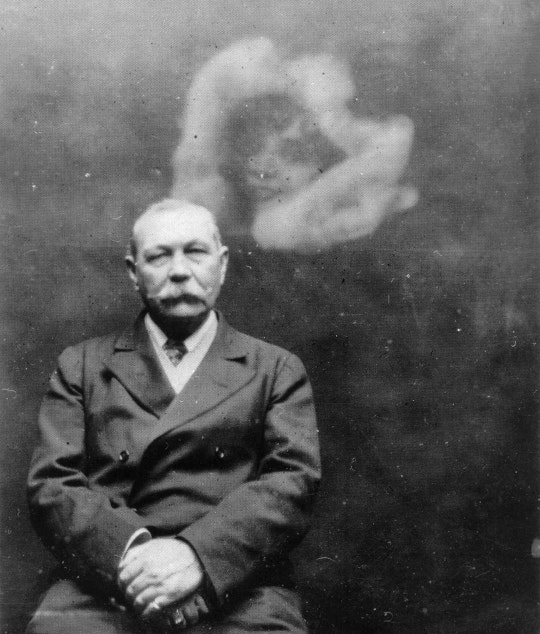
Spirit photograph of Arthur Conan Doyle taken by the 'spirit lensman' Ada Deane in 1922, the same year in which Conan Doyle'southward The Coming of the Fairies was published - Source
In the winter of 1920, readers of the popular British magazine the Strand found a curious headline on the cover of their Christmas issues. "FAIRIES PHOTOGRAPHED," it said. "AN EPOCH-MAKING EVENT DESCRIBED BY A. CONAN DOYLE." The Strand's readership was well acquainted with Sir Arthur Conan Doyle; almost of his wildly popular Sherlock Holmes stories had appeared for the first time in its pages. The great man's merits that fairies –real fairies – had been photographed in the northward of England by 2 young girls was greeted with wonder, but unfortunately for Conan Doyle, most of it was of the "what can he exist thinking?" variety. How could the creator of the world's nearly famous, least-fool-able detective have convinced himself that "fairy" photographs were real? Let u.s.a. continue, Holmes-similar, to examine the question.
Mistake Number One: Misinterpreting the Evidence
To his credit, Conan Doyle made what was (to him) a thorough, scientific, step- by- step investigation of the "fairy" photographs. For his first step, he consulted experts at the London offices of the George Eastman Kodak Company. They examined prints of the first two "fairy" photos and told Conan Doyle they could find no evidence of photo-doctoring; still, they insisted someone who knew plenty about photography could have faked them.
In Conan Doyle's mind, that ruled out the two Yorkshire village girls who had taken the photographs, Elsie Wright and Frances Griffiths. "I argued that we had certainly traced the pictures to two children of the artisan [working] class, and that such tricks would be entirely beyond them," he wrote. Working course girls, surely, would not be able pull off such a hoax….
Mistake Number Two: Our Human Non on the Spot
Conan Doyle'south next step was an on-the-scene investigation – but Conan Doyle himself did not go. Instead, he enlisted a far-from-impartial surrogate -- an agog believer in fairies named Edward Gardner -- to carry out the mission. Gardner had already talked to several people who had assured him the girls had played with fairies and elves since babyhood. He had already written to Elsie Wright's mother begging her to get her "lilliputian daughter" to take more photos. "I know quite well that fairies exist," Gardner wrote in i of several messages to Elsie'due south mother, "and that they are very shy of showing themselves or budgeted adults, and it is merely when one can obtain the help of their 'friends' that one tin can hope to obtain photographs and hence pb to a meliorate agreement of Nature's ways than is possible otherwise." Gardner explained to Elsie's mother that he had long been anxious to obtain photos of "fairies, pixies, and elves, and if possible of brownies and goblins."
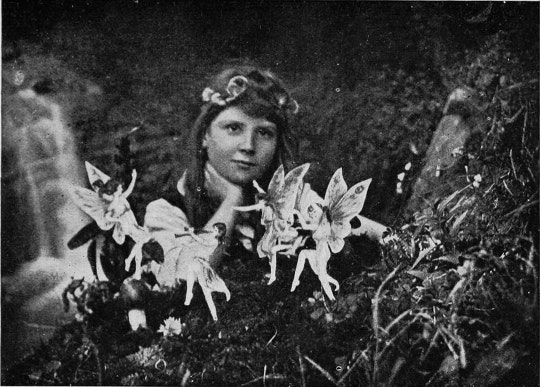
So it is perhaps not surprising that when he actually visited the Wright family in the Yorkshire village of Cottingley, Gardner found no reason to suspect at that place was anything amiss in the photographs. He talked to Elsie's parents, who (not knowing themselves whether or how the photos had been faked) gave him sincere and honest answers. They told Gardner all they knew: that the 2 girls had borrowed Elsie's father'due south camera and gone down to a little hidden valley behind the house where the younger girl, Elsie'southward cousin Frances, believed she saw fairies. The girls had returned a only short time later on with the negative that Elsie'due south begetter adult in his dwelling house darkroom: the outset fairy photo.
 Scroll through the whole page to download all images earlier press.
The first fairy photo, featured in Conan Doyle's The Coming of the Fairies (1922) - Source
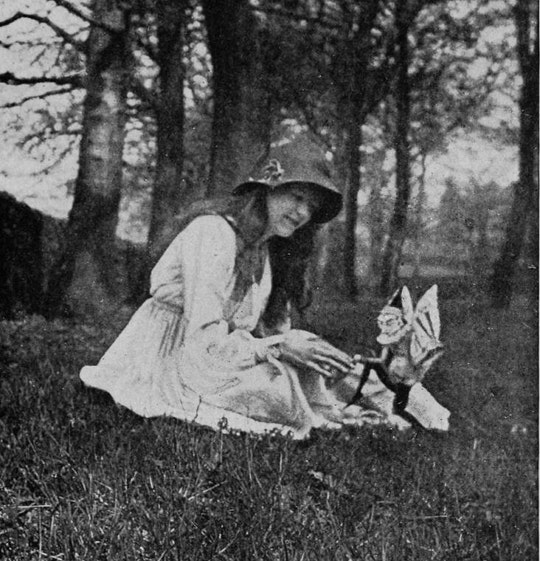
As function of his investigation, Gardner walked with Elsie to the verbal spot, in front of a waterfall, where the photo had been taken. He was glad to accept a run a risk to question the girl alone, he later reported back to Conan Doyle. He asked Elsie what colors the fairies were and she told him they were "the palest of green, pink, mauve," Gardner wrote to Conan Doyle. Elsie also told Gardner the gnome in the second photo had been wearing black tights, a reddish brown jersey, and a ruddy pointed cap. In answer to Gardner's questions virtually the markings on the gnome'due south wings – both Conan Doyle and Gardner thought they looked like a moth'due south wings — Elsie explained that they weren't wing markings at all, only musical pipes. She added that on nevertheless days, y'all could hear the faint, high audio of gnome music. Later on that, Gardner reported back to Conan Doyle that the family's "transparent honesty and simplicity" had convinced him, Gardner, that the photographs were entirely genuine.
 Curl through the whole page to download all images earlier printing.
Elsie and the Gnome, featured in Conan Doyle's The Coming of the Fairies (1922) - Source
Mistake Number Iii: Conan Doyle's and Gardner's misperception of Elsie Wright
To Gardner, Elsie seemed a "shy pretty girl of most sixteen." Just at the time they met, she was actually xviii, going on 19, and for years had cherished the dream of becoming an artist. It was Elsie who had painted watercolor fairies, stuck them to hatpins, and arranged them in the foliage in front of Frances. Information technology was Elsie who, using a complicated, old-fashioned photographic camera to accept her beginning-always photograph, managed to capture the foreign, haunting image that would get down in history as the first Cottingley Fairy Photograph. Gardner had seen a number of Elsie'due south watercolors displayed on the walls of her parents' business firm. Still, he insisted that she was not a good enough artist to have drawn the fairies in the photos, and Conan Doyle believed him.
Mistake Number Four: Creating the Testify
During his visit to Cottingley, Gardner implored Elsie'south parents to become her to accept more fairy photos. Elsie insisted that wasn't possible because Frances had to be there, too, for the fairies to appear. (By that fourth dimension, Frances had moved away from Cottingley to the seaside town of Scarborough). Undeterred, Gardner arranged with Frances' parents for Frances to spend role of her summer holidays in Cottingley. There was nothing either girl could do – the pressure level was on. So when Frances arrived in Cottingley and the two were alone, Elsie told her she'd prepared 2 more cutout fairies, one for each girl. In the hidden valley, the two girls took two more photos. Then they both agreed, in hugger-mugger, they would never take another fairy photograph.
 Roll through the whole page to download all images before printing.
The Dancing Fairy, featured in Conan Doyle'south The Coming of the Fairies (1922) - Source
 Ringlet through the whole page to download all images before printing.
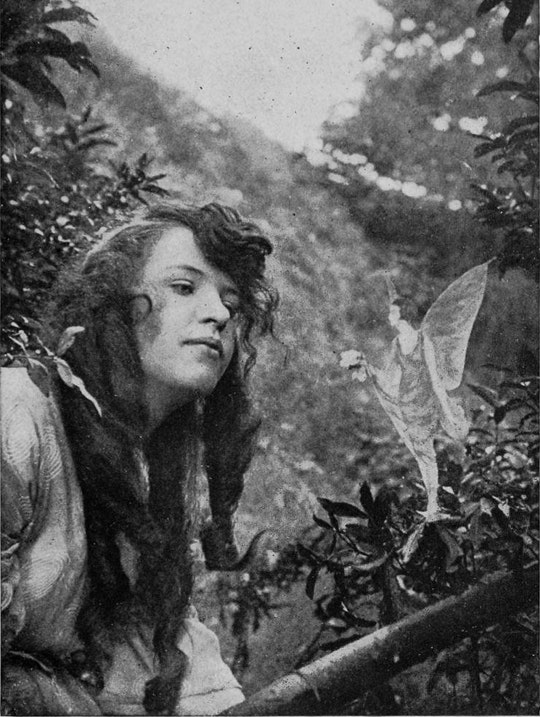
The Hairbell Fairy, featured in Conan Doyle's The Coming of the Fairies (1922) - Source
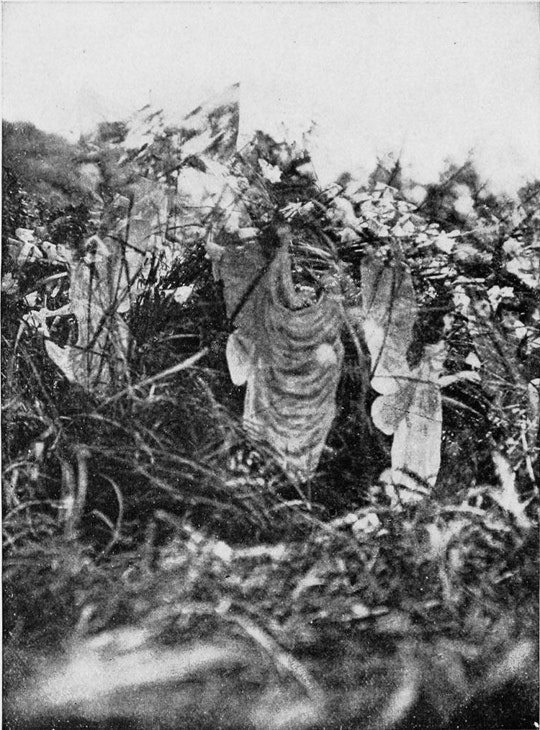
Gardner was delighted to get the ii new photos, but even more thrilled with a 3rd photo, one which Elsie had not faked. Both girls thought at the time it was only a bird'southward nest, some rainwater, some shapes and shadows--simply Gardner insisted it showed fairies. Conan Doyle thought so, as well.
A 2nd Strand commodity, published in March of 1921, announced "The Prove for Fairies by A. Conan Doyle, With New Fairy Photographs." In the article, Conan Doyle quoted Gardner'due south assertion that the tertiary and most amazing photograph was a "fairy bower." Conan Doyle too included Gardner's remark that "We have now succeeded in bringing this print out splendidly." The article did not say what Gardner meant by "bringing out" the impress.
 Whorl through the whole page to download all images earlier printing.
A Fairy Bower, featured in Conan Doyle's The Coming of the Fairies (1922). Elsie and Frances both claim that this detail photo was not faked - Source
The man who had created the world's greatest detective never knew how badly astray his own investigation had gone. In part to avoid embarrassing him, Elsie and Frances did not reveal the surreptitious of the paper cutouts until long afterwards his death. Elsie had once seen what she remembered as "roughshod" cartoon of Conan Doyle in a magazine, and perhaps by and then she realized, too, how desperately he wanted the fairy photographs to exist existent. If the photos were existent, Conan Doyle wrote in The Coming of the Fairies, a book that included both Strand articles, they would provide the beginning solid evidence that whole new orders of invisible beings existed in our world.
"At that place is nothing scientifically incommunicable, so far as I tin come across, in some people seeing things that are invisible to others," Conan Doyle wrote. He did concede that it would take some time before "the ordinary busy human being" realized that "this new order of life is really established and has to be taken into serious business relationship, just as the pigmies of Primal Africa."
"Victorian science would have left the globe hard and clean and blank, like a mural in the moon," Conan Doyle wrote, but now -- with the coming of the fairies -- everything had changed. "One or ii consequences are obvious," he wrote. "The experiences of children will be taken more seriously. Cameras will be forthcoming. Other well- authenticated cases will come up along. These petty folk who appear to be our neighbors, with merely some small deviation of vibration to separate us, will become familiar."
Conan Doyle's belief in spiritualism, séances, and "the spirit globe" is well known, yet his steadfast belief in the Cottingley Fairies is sometimes glossed over or fifty-fifty ignored by biographers. It shouldn't be; it'south a telling glimpse into the character of a man too oft confused with his cold, rational hero.
 Curlicue through the whole page to download all images before printing.
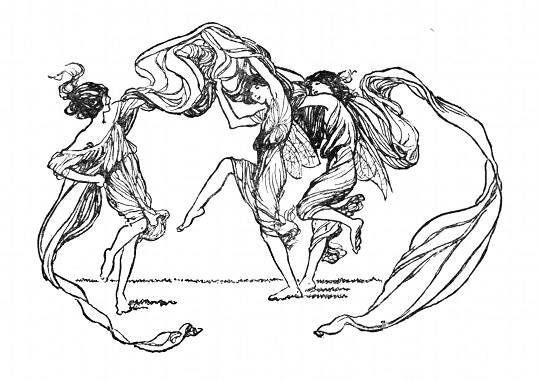
The fairy illustrations from which Frances and Elsie based their cut-out figures, from "A Spell for a Fairy" by Alfred Noyes, published in Princess Mary's Gift Book (1915) - Source
Tags
Get Our Newsletter
balentineresiduchathe.blogspot.com
Source: https://publicdomainreview.org/essay/sir-arthur-and-the-fairies/
0 Response to "What Organization, Founded in 1927, Collects Evidence to Show That "Fairies" Actually Exist?"
Post a Comment